Why does a child not need a life free from frustration, but rather a secure relationship that helps them cope with it?
Contemporary parenting can often make parents feel as though they are facing an almost impossible task: protecting their child from pain, rejection, failure, frustration, fear, and any experience that might leave them with a negative emotional response.
It is natural for parents to want to protect their children. A secure relationship with a caregiver is one of the important factors supporting psychological and social development. However, protection does not mean eliminating every source of discomfort or intervening in every difficult experience a child encounters.
Healthy psychological development does not require the complete absence of challenges. Rather, it requires challenges that can be tolerated within a safe and supportive environment, together with appropriate support from adults. Scientific literature on psychological resilience suggests that experiencing manageable levels of adversity while having a supportive relationship can contribute to developing coping and adaptation skills.
From Protection to Overprotection
It is important to distinguish between appropriate parental protection and excessive protection.
Appropriate protection means that a parent intervenes when a child is exposed to genuine danger, or when an experience exceeds the child's developmental ability to cope with it, while providing the support the child needs.
Overprotection, on the other hand, occurs when the primary goal becomes preventing the child from experiencing any degree of frustration, failure, or discomfort, even when the experience is safe and developmentally appropriate.
Multiple studies have examined the relationship between parental control, overprotection, and anxiety in children. Reviews and meta-analyses indicate an association between certain forms of parental control and excessive protection and anxiety symptoms, while emphasizing that these relationships are complex and correlational rather than representing a simple cause-and-effect relationship.
A large meta-analysis also found that overparenting was associated with higher levels of anxiety, depression, and certain internalizing symptoms among offspring, although effect sizes varied from small to moderate depending on the outcome examined.
Therefore, it cannot scientifically be claimed that every form of parental intervention leads to psychological weakness, nor that all forms of protection are harmful. The issue depends on the type and degree of protection, the context, the child's age, the nature of the situation, and the child's individual needs.
Frustration Is Part of Learning, not a Parenting Failure
As children grow, they encounter many everyday situations involving natural and manageable frustration:
Another child may refuse to play with them.
They may lose a game.
They may hear the word “no.”
They may have to wait for their turn.
They may not get what they want immediately.
They may fail to complete a task on their first attempt.
They may disagree with another child over a toy, a turn, or a rule.
These experiences should not always be viewed as problems that need to be eliminated.
When an experience is safe and appropriate for the child's age, it can become an opportunity to develop important skills such as emotional regulation, problem-solving, psychological flexibility, patience, asking for help, and managing disagreements.
The literature on building resilience emphasizes that children do not develop these abilities by avoiding every source of stress. Instead, resilience develops through the interaction between manageable challenges and supportive relationships that help children build coping skills.
A Parent's Role Is Not Always to Remove the Problem
When a child experiences a problem with a peer, it may be easier for a parent to intervene immediately and resolve the situation.
When a child cries because their request has been refused, giving in may seem like the quickest way to stop the crying.
When a child struggles with a task, it may be easier for the parent to do it for them.
However, intervening in every situation can sometimes deprive children of opportunities to practice skills they need to learn.
This is where the concept of developmental scaffolding becomes important: the adult provides the amount of support the child needs and gradually reduces that support as the child's ability to handle the situation grows.
The Center on the Developing Child at Harvard University highlights the importance of age- and context-appropriate support in developing executive functions and adaptive skills. Adults can help children begin, practice, and intervene when necessary, while still allowing children opportunities to gradually develop their own capabilities.
This means that the parenting question does not always have to be:
“How can I prevent my child from feeling frustrated?”
It can instead become:
“How can I help my child deal with frustration in a way that is appropriate for their age?”
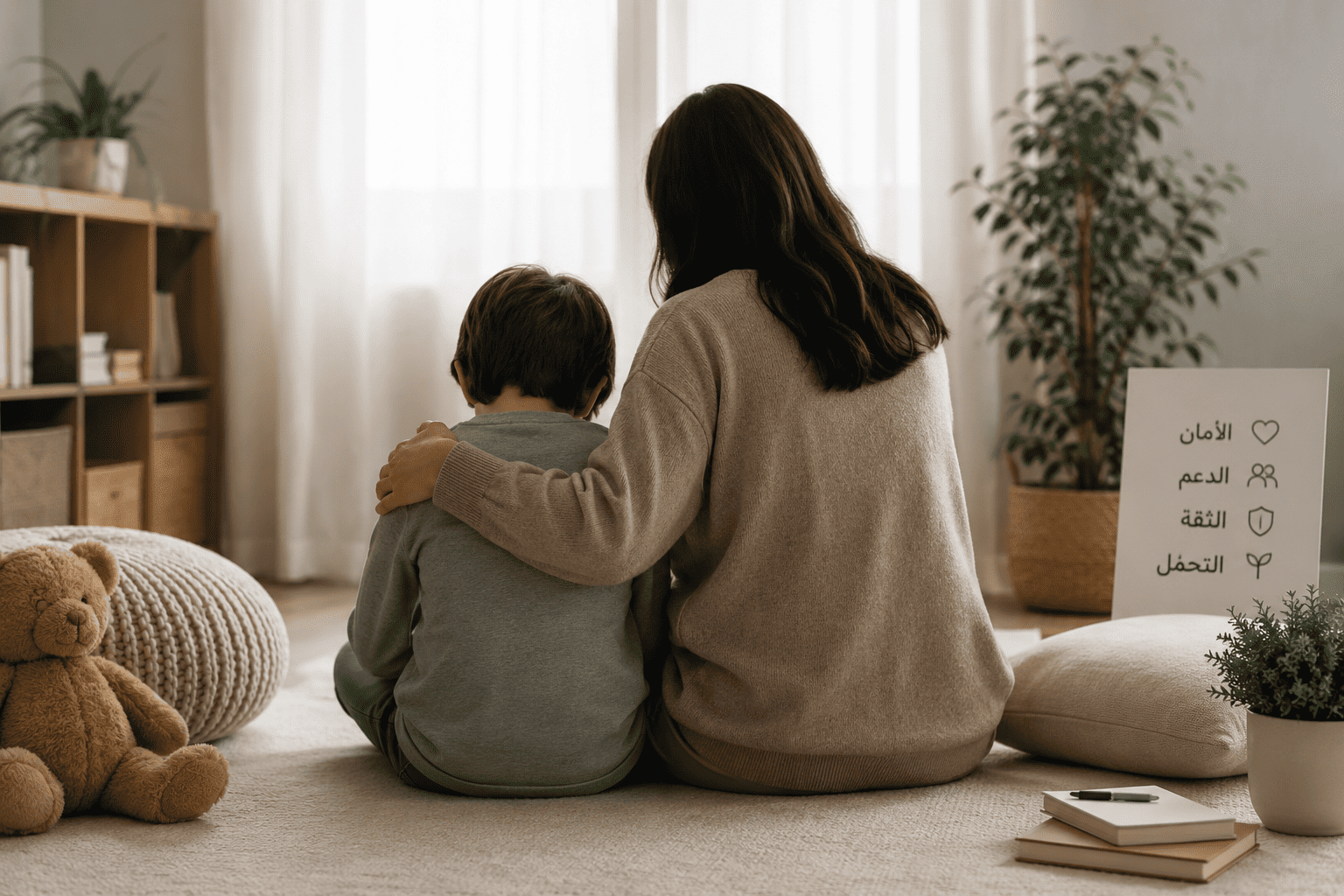
A Child Does Not Need a Parent Who Prevents Pain, but a Parent Who Can Accompany Them Through It
A child experiencing frustration does not mean that we should leave them alone.
On the contrary, a supportive relationship is an essential part of building resilience.
A child who cries after losing a game can hear a parent say:
“I know you really wanted to win, and it is completely understandable to feel sad.”
Then, gradually, the conversation can move toward:
“Would you like us to think together about what you could do differently next time?”
In this way, the child's feelings are neither denied nor immediately removed, while the child is also not left alone to deal with them.
The evidence summarized by Harvard University's Center on the Developing Child indicates that having a stable and supportive relationship with a responsible adult is an important protective factor in children's ability to cope with adversity. Responsive relationships also help children regulate emotions and develop the skills needed for adaptation.
What About the mother?
It is also important that this message does not become another burden placed on mothers.
A mother does not need to remain calm all the time, respond perfectly to every situation, or carry the responsibility for building her child's resilience alone.
The literature indicates that parents' behavior is itself influenced by levels of anxiety, stress, and surrounding circumstances. The relationship between parental anxiety and parental control is also complex and reciprocal.
The child-development framework further emphasizes that supporting children should not be the responsibility of caregivers alone, as social, economic, and environmental pressures can also affect parents' ability to provide a stable and responsive environment.
Therefore, conscious parenting does not mean asking a mother to be “perfect.” Instead, it means helping her move from:
“My child must not suffer.”
to:
“I want to be there when my child is hurting and help them learn what they need from the experience.”
When Should We Protect a Child, and When Should We Give Them Space to Experience?
The determining factor is not simply how uncomfortable the child feels, but the nature of the situation.
If a child is experiencing violence, ongoing bullying, genuine danger, or a situation that exceeds their developmental capacity to cope, intervention and protection are essential responsibilities.
However, when a child is experiencing age-appropriate everyday frustration—such as waiting, losing a game, hearing a reasonable refusal, or attempting a new task—it can be beneficial to give them space to try and learn, while keeping a supportive adult nearby.
The goal is therefore neither to deliberately expose children to pain nor to eliminate every source of pain from their lives.
The goal is to provide an environment in which children can experience developmentally appropriate challenges, feel safe, receive support, and gradually develop the ability to cope with those challenges.
Conclusion
Healthy parenting is not measured by how many times we succeed in preventing our child from crying, nor by how many problems we solve on their behalf.
What matters more is whether, over time, the child learns that they can:
Feel emotions without being overwhelmed by them.
Face rejection without falling apart.
Lose without seeing themselves as a failure.
Disagree without destroying their relationships.
Fail without giving up.
Ask for help without depending on others to solve every problem.
Psychological resilience does not mean that a child never experiences pain. It means that, over time, they develop the psychological and social resources that help them cope with pain and adapt to it.
And perhaps, rather than raising children who are protected from life, we need to raise children who feel safe enough to experience life, and supported enough to learn how to face it.